Project lead: James Camac
The Australian plague locust, Chortoicetes terminifera (Ct), poses a serious threat to agriculture in eastern Australia. These locusts are notorious for forming large swarms that travel great distances and consume substantial amounts of vegetation, resulting in significant damage to crop production and grazing areas.
During peak outbreaks, economic losses can amount to approximately AUD 30 million per year. In response to this ongoing challenge, the Australian government established the Australian Plague Locust Commission (APLC) in 1974 to coordinate monitoring and response to this threat across New South Wales, Queensland, Victoria, and South Australia.
The APLC is responsible for monitoring, forecasting, researching, and implementing control measures to quickly detect and respond to locust outbreaks, thereby minimising economic impact. A recent review of APLC operations, governance, and research (Healy et al., 2024) highlighted several important recommendations. One critical need identified was for the APLC to enhance its monitoring and forecasting system to a real-time online platform that predicts and maps regional locust risks, allowing for more effective targeting of control efforts.
This project is committed to transforming APLC operations by significantly enhancing access to data and model forecasting. It directly responds to a crucial recommendation from the review of APLC operations, governance, and research (Healy et al., 2024), which underscored the urgent need for the APLC to upgrade its monitoring and forecasting system to a real-time online platform. This upgrade will empower the prediction and mapping of regional locust risks, facilitating more precise targeting of control and monitoring efforts.
The objective of this project is to develop a cloud-based analytics dashboard to inform and improve operational management of monitoring and control activities undertaken by the Australian Plague Locust Commission. This dashboard will allow:
- The visualisation of more than 37 years of APLC monitoring and control activities undertaken across New South Wales, Queensland, Victoria, and South Australia.
- The fitting and projection of short-term (1-2 week) and seasonal (3 monthly) forecasts of locust population dynamics. The project will also operationalise the forecasting tool developed in the previous CEBRA locust project.
- The ability to overlay a variety of cutting-edge environmental and satellite-derived data products, which the APLC consider essential for locust prediction (e.g. NDVI, Pasture Growth Index (PGI), Rainfall, temperature and soil moisture anomalies, vegetation and land use type).
To achieve this, the project will consolidate and operationalise decades of APLC research and model development. It will harness cutting-edge spatial and environmental datasets developed by various government and non-government organisations, and leverage existing analytics and datasets available in the national biosecurity risk analysis platform, Biosecurity Commons (www.biosecuritycommons.org.au).
By developing functionality on Biosecurity Commons, the APLC can capitalise on previous investments made by the Department of Agriculture, Fisheries and Forestry (DAFF), the Australian Research Data Commons, and other governmental and non-governmental entities. This approach will enable the APLC to tap into existing functionalities and datasets available on the platform, as well as leverage the substantial computational resources it offers.
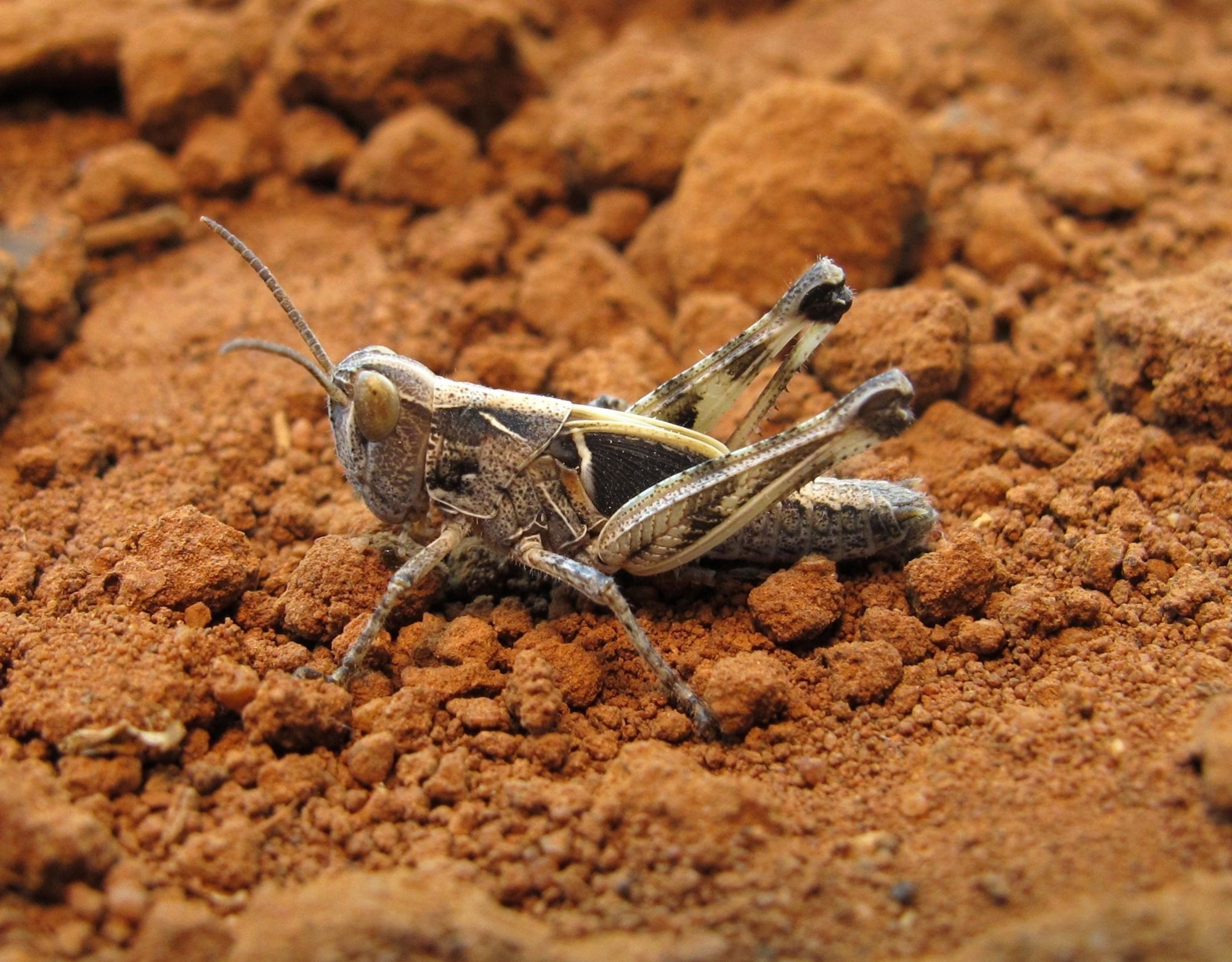
Picture credit: Australian Plague Locust (Chortoicetes terminifera) fifth instar nymph, Dr Gordon Berg. Vic APLC Commissioner (ret)