Project lead: Susie Hester
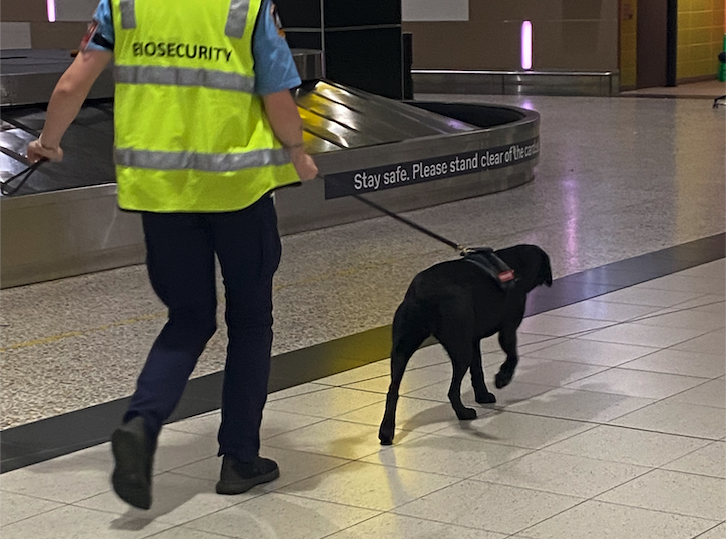
Biosecurity detector dogs are currently deployed at Australian international airports to detect biosecurity risk material (BRM) brought in deliberately or inadvertently by international travellers. While the detection capability of dogs is reasonably well-studied, their impact in deterring non-compliance remains largely unexplored.
This project will investigate the deterrence capability of biosecurity detector dogs in the airport context, focusing on arriving international travellers. Using a mixed-methods approach, the project will involve analysis of existing data, interviews with travellers, one or more randomised control trials (RCT), data analysis, and potentially a trial in which detector dogs are deployed to explicitly understand their deterrent capacity.
The project findings will support evidence-based deployment strategies aimed at maximising the value of Australia’s investment in dogs as an intervention tool. By improving how and when detector dogs are used, this project seeks to enhance the efficiency of resource allocation at the border and to reduce the likelihood of BRM entering the country.
Ultimately, the project will contribute to stronger biosecurity outcomes by minimising the risk of incursions that could harm Australia’s economy, environment, culture, or way of life. The timing is appropriate given increasing traveller volumes, the establishment of new international airports, and the need to ensure interventions are both effective and efficient.